
Checking Criminal History in Erie County
No single database contains every Erie County criminal record. Begin with the free Unified Judicial System Case Search when the question concerns a filed case. Select the Court of Common Pleas or Magisterial District Court, choose Erie County and the criminal category, then search by docket number or participant name. A date of birth or filing range can help separate common names. Read each charge and disposition, since the case caption alone does not state the result.
A full name, spelling variants, approximate date, and known agency make the search far more precise. For a paper file or certified copy, use the Clerk of Courts. Call Erie County Prison for current county custody, and use PATCH when an official statewide Pennsylvania repository result is needed. Follow this order for a broad self-review:
- Search Erie County MDJ and Common Pleas dockets in the UJS portal.
- Open the docket sheet and compare each count, event, bail entry, and disposition.
- Ask Room 103 for the local adult search or documents that are not online.
- Call the prison for current custody, charges, or bond when recent booking is the issue.
- Order PATCH or the subject-only Access and Review report for official statewide data.
The Erie County Courts source shows how court departments are organized.
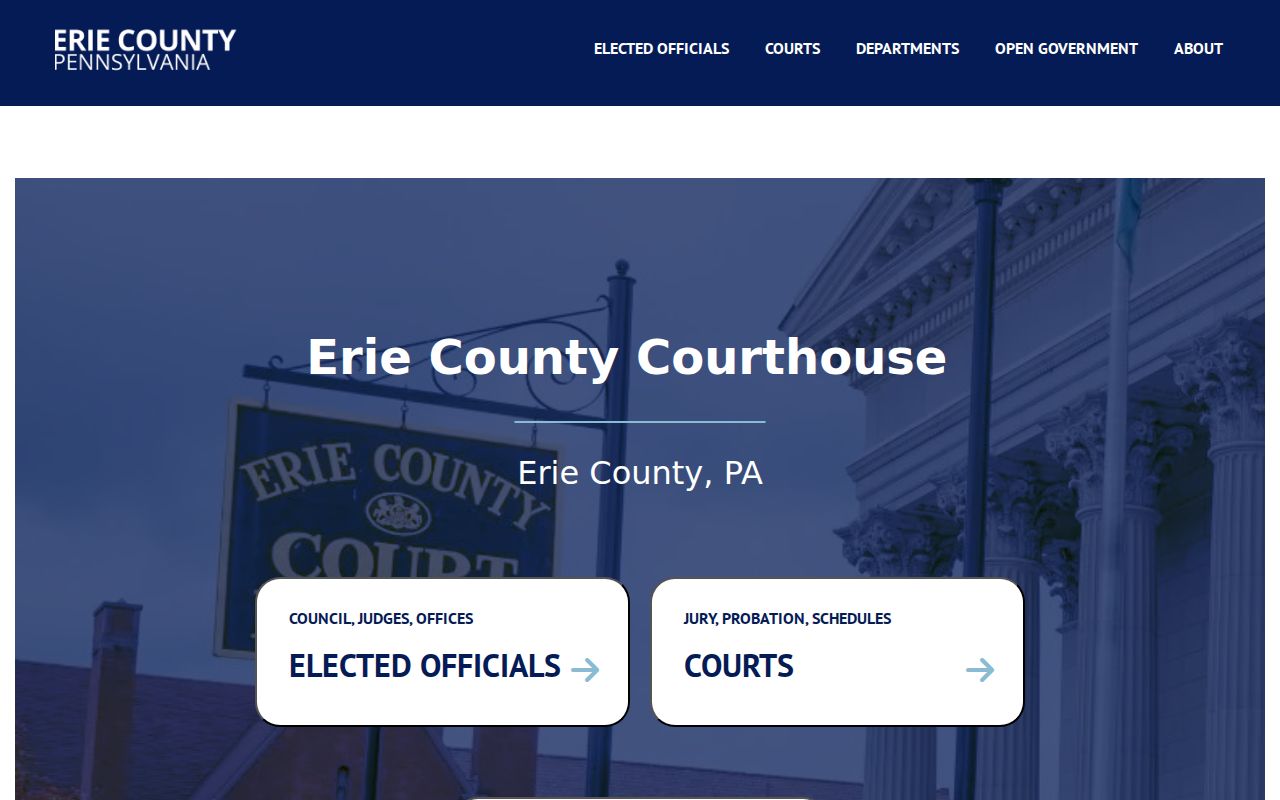
That court gateway leads readers toward the office that owns a docket or filed document instead of a generic county counter.
Why Erie County Records Stay Split
One arrest can create four records. The arresting police agency writes the incident and arrest narrative. Erie County Prison records intake and custody. A Magisterial District Judge opens the complaint, arraignment, bail, and preliminary-hearing docket. For fingerprintable offenses, the arrest data also travel to the Pennsylvania State Police Central Repository, while later court outcomes complete the repository cycle.
These sources may disagree without any one of them being false. Initial charges can change. A web docket may lag a new arrest, and PSP may still await a disposition. A local report can contain facts that never appear on a public docket. Use the source that answers the question, then verify a disputed field with the office that created it.
| Channel | Best use | Erie County route |
|---|---|---|
| Police report | Event narrative and officer action | Arresting city, township, campus, or PSP agency |
| Booking record | Current custody, charge, and bond | Erie County Prison telephone line |
| Court docket | Filed counts, hearings, and outcome | UJS portal or the filing court |
| Repository result | Reported Pennsylvania criminal history | PSP PATCH or Access and Review |
Pennsylvania Official Background Checks
The Pennsylvania State Police Bureau of Records and Identification runs Pennsylvania Access To Criminal History, known as PATCH. An ordinary online or mailed name check costs $22. Notarization adds $5. The product covers data reported by Pennsylvania agencies, not FBI or other-state files. A “No Record” certificate does not prove that no Erie County police contact or sealed court matter ever existed.
People reviewing their own complete Pennsylvania record can mail the subject-only SP 4-170 Access and Review request with fingerprints and a $20 fee. It includes nonconviction information for review and correction. By contrast, IdentoGO enrollment serves programs that issue a specific service code. Do not guess that code. A federal self-check runs through the FBI Identity History Summary process and requires fingerprints.
| Official product | Method | Published fee |
|---|---|---|
| PATCH name check | Online or SP 4-164 by mail | $22 |
| Notarized PATCH result | Add notarization to eligible check | $27 total |
| PSP Access and Review | SP 4-170 with fingerprints, mail only | $20 |
| FBI Identity History Summary | Electronic request plus fingerprints | $18, before any channeler fee |
The FBI electronic request source illustrates the federal identity-history route.
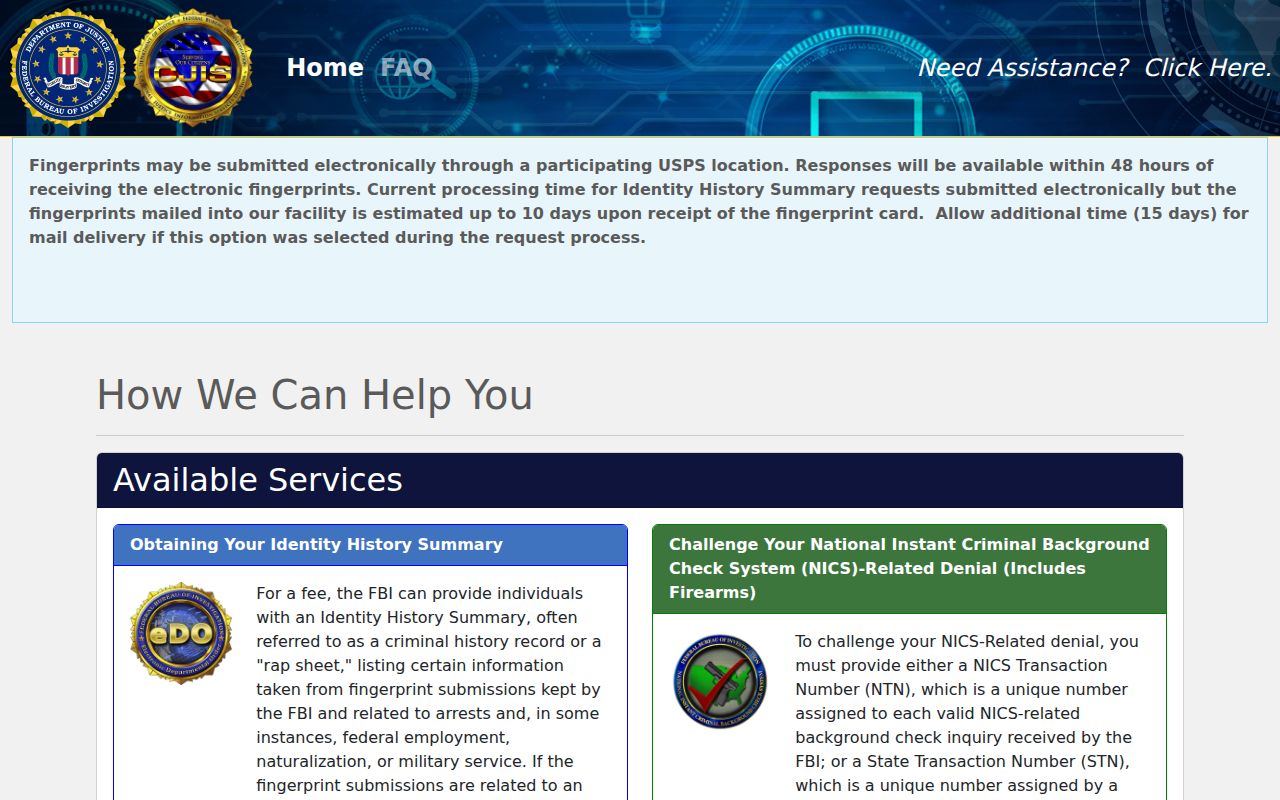
This federal process is broader than PATCH by geography, but neither product replaces Erie County court and police records.
PATCH Review and Erie County Records
PATCH lets a nonregistered requester submit up to ten checks in one session. The form collects requester details, the subject’s name, aliases when known, date of birth, sex, race, and other available matching data. It assigns a control number. Save that number and the final certificate because the nonregistered workflow does not retain requester and payment data for later retrieval.
A status of “Request Under Review” is not a finding that a record exists. PSP reports that most no-record results issue at once, while a potential match can require manual review for two to four weeks. Status validation uses the control number, request date, and subject name exactly as entered. When the result conflicts with an Erie County docket, identify whether the disputed field came from the court, arresting agency, or repository before asking for correction.
The official PATCH entry source shows the request and certificate routes.
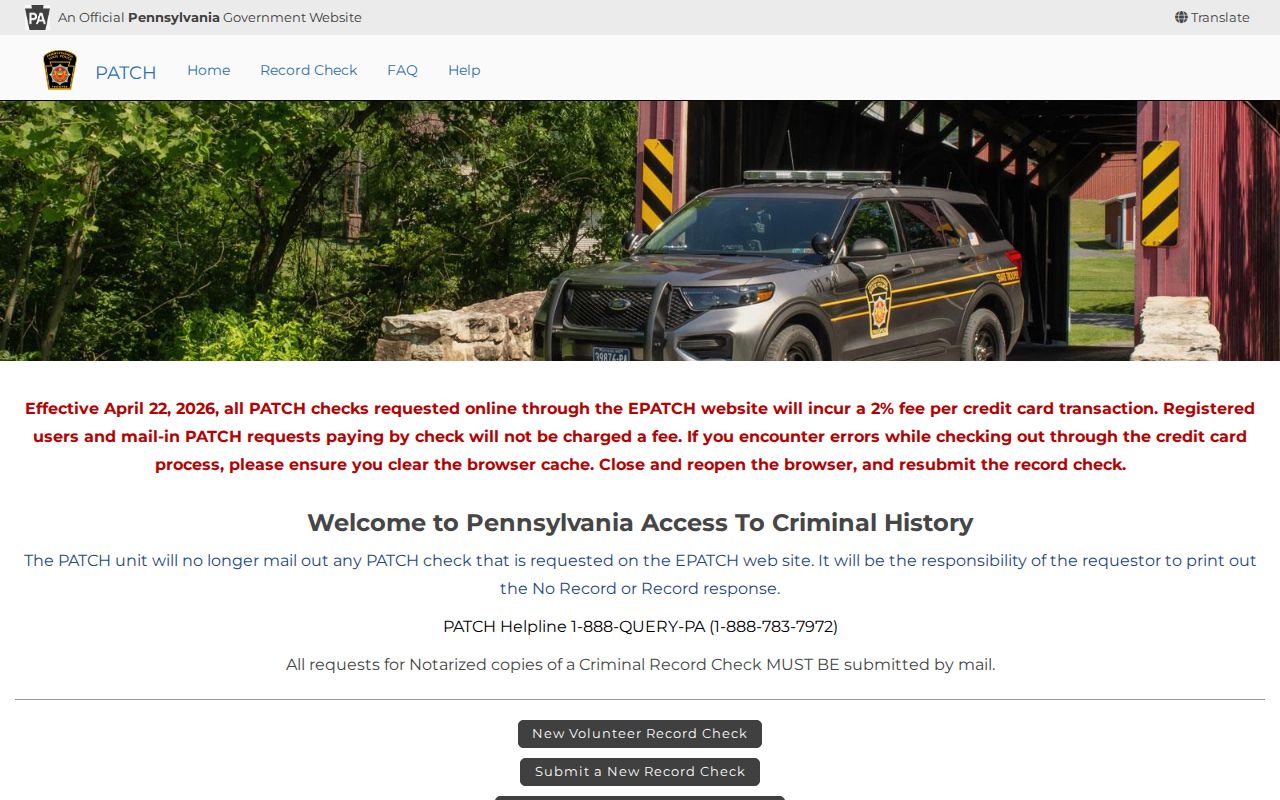
The screen is the state repository gateway, not an Erie County docket, booking log, or police-report portal.
Criminal Record Types
Erie County record types reflect the stage and office that made them. An incident report describes an alleged event. A booking entry records custody, not guilt. MDJ and Common Pleas dockets track litigation. PATCH summarizes data reported to PSP. A warrant entry shows court authority, while supervision records concern probation or parole. Registry listings publish only information allowed by Pennsylvania law for active registrants.
The most useful distinction is custody versus case outcome. Erie County Prison can confirm that someone is held and state current charge and bond information, but the court decides bail and the final disposition. The Erie County criminal court case record supplies deeper detail on filed counts and sentencing.
- MDJ docket
- The minor-court file for the complaint, preliminary arraignment, bail, and preliminary hearing.
- CP-25-CR docket
- An Erie County Common Pleas criminal case; 25 is the county code.
- Disposition
- The count-specific result, such as guilty, dismissed, withdrawn, acquitted, or nolle prossed.
- Limited access
- A restriction on ordinary public release that does not erase every official use.
Room 103 Erie County Record Counter
The Clerk of Courts in Room 103 of the Erie County Courthouse holds adult Common Pleas criminal filings. Its file can include motions, pleadings, pleas, transcripts, disposition, sentence, appeals, and financial entries. The office advertises a $10 adult criminal-record search. It is open weekdays from 8:00 a.m. to 4:30 p.m. at 140 West Sixth Street and can be reached at 814-451-6221 or clerksrequests@eriecountypa.gov.
Quote the full docket number when requesting a copy, certification, or older material. Room 103 is not the right desk for a City of Erie police narrative, county booking status, or PSP repository certificate. Complex judicial-record requests go to the Common Pleas Records Manager under court access rules, while ordinary file questions should begin with the Clerk.
Clerk of Courts
Room 103, Erie County Courthouse
140 West Sixth Street, Erie, PA 16501
814-451-6221
Weekdays, 8:00 a.m.-4:30 p.m.
Erie County Prison
1618 Ash Street, Erie, PA 16503-2168
814-451-7500
Current county custody, charges, bond, and facility information
Inside an Erie County Criminal Record
A repository record usually starts with identity data, aliases, birth details, a State Identification number, and fingerprint transaction identifiers. It then groups arrest cycles with agencies, dates, offenses, tracking numbers, dispositions, and reported sentences. A public Erie County docket uses a different layout. It can show the caption, case status, filing dates, counsel, bail, events, charge grades, outcomes, sentence, and a dated list of filings.
| Name & Identifiers | Legal name, aliases, birth data, and repository or docket identifiers where public. |
|---|---|
| Arrest / Booking Data | Arrest date and agency, intake facts, initial charge, and custody information. |
| Charges & Statutes | Count number, Pennsylvania section, offense description, and grade such as F2 or M1. |
| Disposition | The result for each count, which may differ from the overall caption. |
| Sentence | Confinement, probation, fines, costs, restitution, or other court terms when public. |
| Custody / Supervision | County custody comes from the prison; state prison and parole data come from PA DOC. |
Protected identifiers, victim details, juvenile material, and sealed filings do not appear on the ordinary public Erie County docket sheet.
Erie County Phone-First Inmate Records
Erie County does not publish an official online booking roster found in the research sweep. The authoritative path is a call to Erie County Prison at 814-451-7500. Give the full legal name and, when possible, date of birth or booking number. Staff can address current custody, charge descriptions, bond, visitation, mail, funds, property, medication, and phone-use questions.
The Pennsylvania Inmate/Parolee Locator serves a different population. It updates daily for people in state custody or under DOC parole supervision and expressly excludes county-jail inmates. If an Erie County sentence later results in transfer to PA DOC, switch to that locator. A missing state result does not rule out current detention on Ash Street.
The PA DOC locator source displays the state-level search.
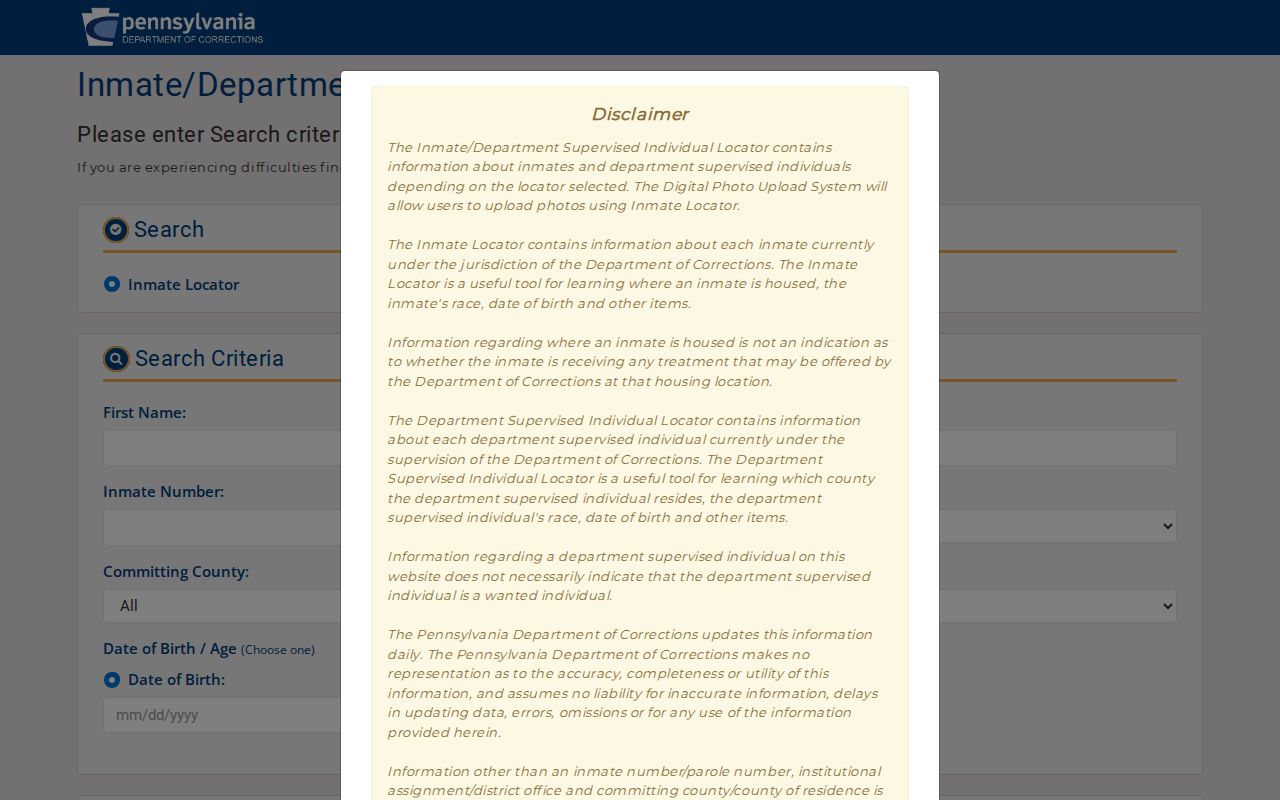
Its statewide results complement, but never replace, Erie County Prison’s phone-first custody check.
Public Access Laws in Pennsylvania
The Pennsylvania Right-to-Know Law opens many agency records but does not make every criminal file public. Erie County cannot supply a municipal police report it does not own. Judicial records follow the Unified Judicial System access policy and Pa.R.J.A. 509. Criminal investigative material, juvenile records, victim and minor details, medical facts, security data, and sealed matters may be withheld or redacted.
Send each request to its custodian. City police decide access to their reports, Erie County Prison handles current booking facts, the Clerk handles Common Pleas files, and PSP handles repository data. RTKL asks for an existing record; it does not require an office to answer questions or create a new report.
Key Pennsylvania rules:
Pennsylvania Right-to-Know Law sets agency-request and appeal rules, subject to exemptions.
18 Pa.C.S. § 9121 controls noncriminal-justice dissemination of criminal-history data.
UJS Case Records Public Access Policy governs remote and counter access to judicial case records.
18 Pa.C.S. §§ 9111-9114 address completeness, reporting, and correction of inaccurate history.
Erie County Warrant Record Scam Warning
Erie County has no verified public warrant-name database. A public UJS docket may show a bench-warrant event, but the secure warrant system is not open for general name searches. The Sheriff’s Warrant Division executes Common Pleas bench warrants and processes fugitive matters. The Sheriff’s main office at 814-451-6007 can verify a suspicious warrant-related call; the current confidential tip line is 814-451-7436.
Never pay an unsolicited caller who claims money will stop an arrest or citation. The Erie County Sheriff states that its office does not make such demands by phone. Verify the docket and issuing court, ask about a lawful appearance or surrender process, and keep proof of any later withdrawal. A cleared warrant event can remain visible for a short time while systems update.
The Erie County Warrant Division source confirms the office’s role and contact route.
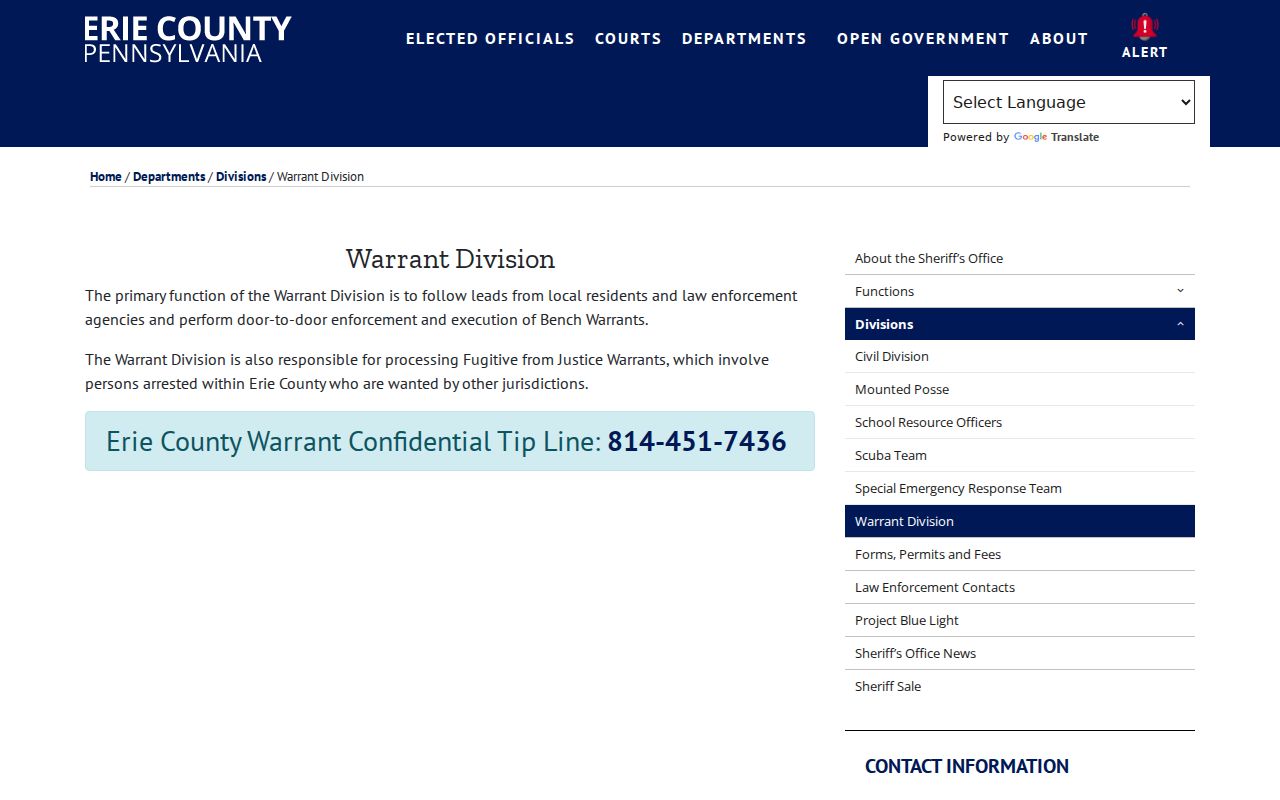
The official page is the safer check for warrant claims than a caller’s number or an unofficial people-search result.
Sealed, Expunged, and Restricted Records
Pennsylvania treats expungement and limited access as different relief. Expungement can remove eligible nonconviction records and certain narrow conviction records. Successful Accelerated Rehabilitative Disposition may support expungement through the applicable criminal rules. Limited access blocks ordinary public dissemination of qualifying matters but preserves authorized criminal-justice uses. Clean Slate can grant limited access to defined offenses after statutory conditions are met.
Erie County’s Clerk offers local ARD expungement forms, petition instructions, proposed orders, limited-access forms, a Pardon Project intake form, and a PSP Access and Review form. Local instructions call for the PSP record and a docket sheet for each case. Filing goes to Room 103, with required notice to the District Attorney and final action by a judge. Confirm the current filing fee with the Clerk because the official source did not publish a stable amount.
A dismissal does not become invisible by itself. After relief is granted, recheck the UJS display and later obtain a PSP review when appropriate. Juvenile expungement follows separate rules, and restricted material may still exist for expressly authorized purposes.
Erie County Fingerprints and Record Flow
For fingerprintable arrests, the agency or Erie County Prison creates identity and transaction data that must flow to the PSP Central Repository. The MDJ court supplies early case events. If charges are held for Common Pleas, the District Attorney files the information and the Clerk becomes custodian of that court file. Courts and justice agencies then report dispositions so PSP can connect the arrest cycle with its outcome.
IdentoGO by IDEMIA captures fingerprints for Pennsylvania programs that provide a service code. Its live locator is better than a fixed Erie County storefront list because sites and appointments can change. For a personal Pennsylvania Access and Review request, PSP instead directs the subject to submit SP 4-170 with fingerprints by mail.
The official IdentoGO enrollment source shows the service-code workflow.
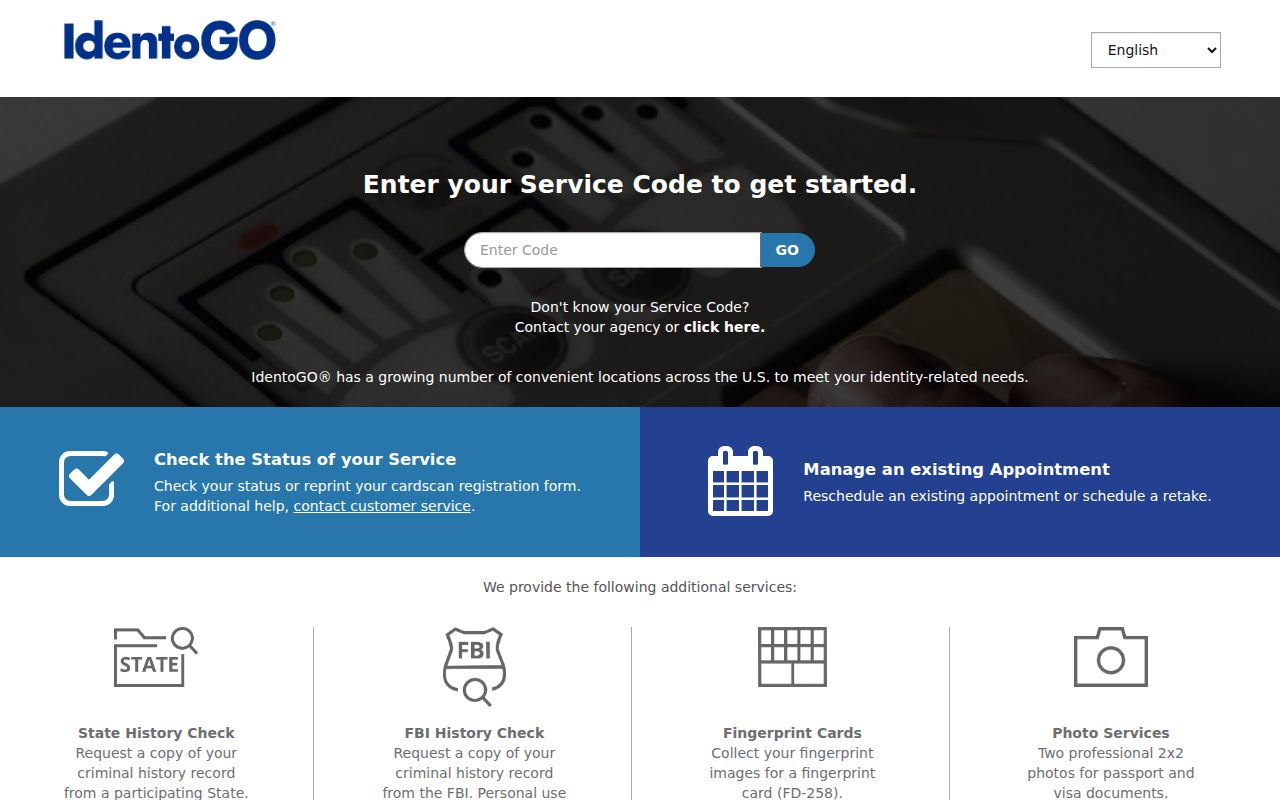
This enrollment screen serves authorized fingerprint programs; it is not a public Erie County name-search database.
Fixing an Erie County Record Error
Start with the source of the wrong field. A misspelled name or incorrect event on a public docket should be raised with the filing court through the UJS correction route. An incorrect police narrative belongs with the arresting agency. For a suspected repository error, first obtain your full PSP Access and Review record, identify the arrest or disposition entry, and use the challenge process under 18 Pa.C.S. § 9114.
Bring the docket number, arrest tracking number when known, charge and disposition, and documents that show the correct fact. Reporting lag is not always an error. The originating court may need to correct its entry and send the revised disposition to PSP before PATCH changes. Keep copies and check both systems after the update.
Erie County Probation Record Programs
Erie County Adult Probation, part of the Sixth Judicial District, supervises county probation and county-parole cases. Its named Community Oriented Probation Services program works with the Housing Authority of the City of Erie. The court also supports Veterans Treatment Court and other alternatives for eligible participants. These are supervision and court programs, not public name databases.
Use the UJS docket to verify the sentence or a public revocation event. Internal supervision notes, conditions, and risk material can be restricted. State parole is different: the Pennsylvania Parole Board makes release decisions, and PA DOC administers supervision. The DOC locator can show public state-parole status while excluding people held only in the county prison.
The Erie Adult Probation source describes the local unit and its programs.
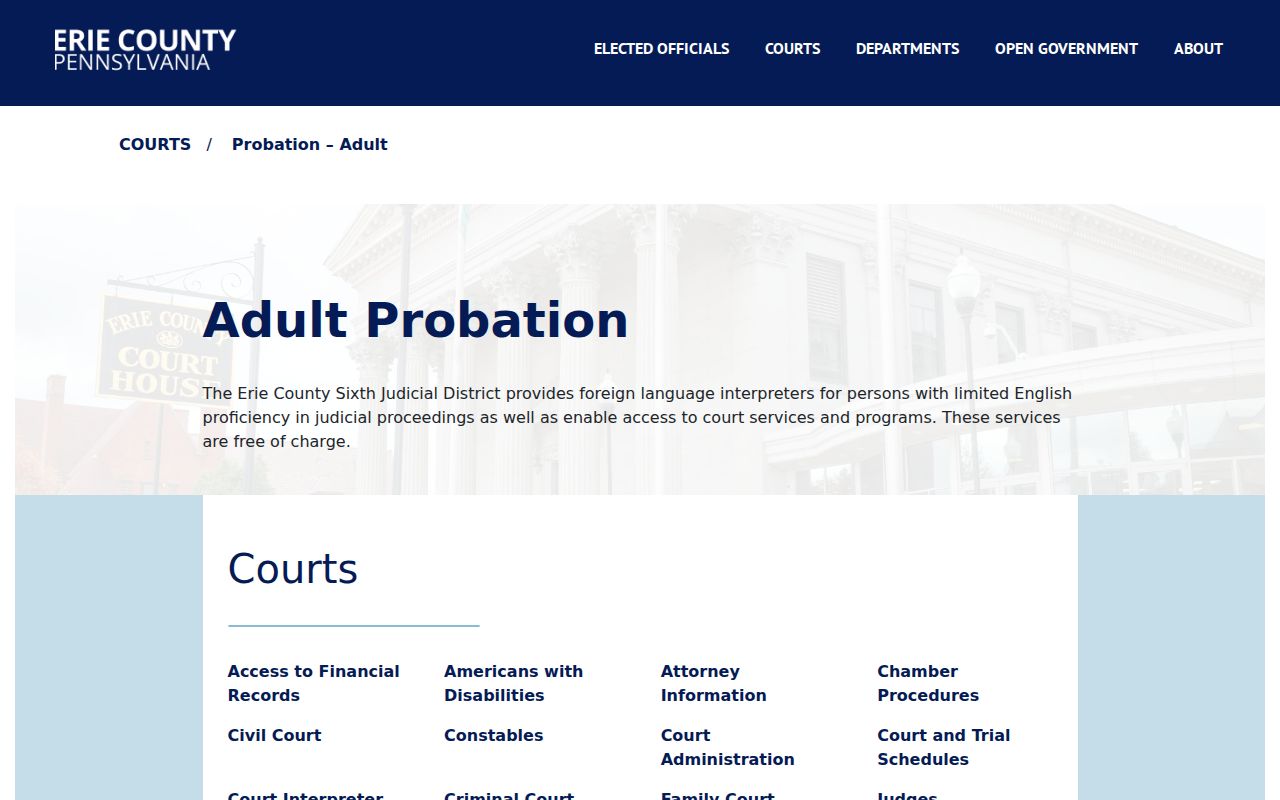
The program page helps distinguish county supervision services from PA DOC parole records and court docket entries.
Erie County Criminal Records by City
Erie County has two incorporated cities: Erie and Corry. Each police department keeps its own incident and arrest reports, but neither city runs a separate criminal-court system. Their cases use assigned Magisterial District Courts and, when held for court, the Erie County Court of Common Pleas. Booking and custody after transport belong to Erie County Prison. The cards below match the two city record paths.
Erie Criminal Records
92,940 residents in the 2024 estimate · Bureau of Police reports stay with the city; court files move through county dockets.
Corry Criminal Records
6,210 residents in the 2020 Census · Corry Police records stay local; booking and court records use county channels.